

#6 The Lover(s)
Despite the systems and people actively attacking your happiness, human rights, dignity, our natural home, etc., we must create a beautiful life.
Please read about the Tarot Tracklist for my approach working with tarot cards.
The tarot deck has been around since the 15th century. You can imagine the card appearances have changed over the centuries, most notably #6. In the Marseilles deck, the version analyzed in “Tarot of the Archetypal Journey” by Sally Nichols, you’ll notice this card is not the same name as the popular Rider-Waite version. The Lover vs. Lovers. At the Tarot Tracklist, I am using Nichols’ book as my primary reference material for Jungian archetypes within the tarot, so for consistency, we will also follow the Marseilles depiction of #6—The Lover.
The Lover corresponds to the astrological sign of Libra and the planet Venus. The Lover is an air sign relating to psychological intelligence and mental sharpness. If related to Libra, The Lover also will need to employ the necessity of balance. A key challenge for The Lover is learning the difference between reacting and responding to life’s everyday realities. These realities may represent family vs spouse, old vs new, inside vs outside. There are choices we will have to make in life that will create an absence. There are always opportunity costs when making decisions. But a decision must be made. You cannot stand still forever.
The Lover is the first card in the Major Arcana, where the central image is not magical or a godlike character, instead we see a human firmly planted in the present. To embody The Lover, we must do the same.
We are almost at the end of our first realm in the Major Arcana, so let’s recap who we’ve met along the way.
#1 The Magician, where the hero learned the importance of intimately knowing your resources and that alchemy is possible through precision.
#2 The High Priestess resides on the shores of the subconscious. She taught us there is more to the hero than meets the eye, more than we can ever grasp.
#3 The Empress showed us growth comes from death.
#4 The Emperor who builds a better future for civilization
#5 The Hierophant where we asked for the meaning of life and learned it was to change.
Now we’re here, where no authority figure is present to appeal for help. This is our first actual decision in the tarot. Libra’s inward guidance helps us embody this archetype by balancing the heart’s and head’s desires (or anima and animus). And Libra, ruled by Venus, believes life should have fun and beauty and joy. You should be enjoying your life. Despite the systems and people actively attacking your happiness, human rights, dignity, our natural home, etc., we must create a beautiful life.
“The opposite of war isn’t peace, it’s creation.” Johnathan Larson.
In the end, the Lover card is not about romantic love. It certainly can mean bliss and romantic relationships, but tarot cards are for self-reflection. So when I embody The Lover archetype, it may mean I reflect on my romantic relationship, but it also may call me to reflect on whether I want to continue living my life as I currently am.
There’s a cultural belief that long-distance relationships (LDRs) don’t work. We hear that argument in every romcom where distance (whether time or location) is the major barrier for why “this can’t work.” Long distance is more the catalyst than the cause. LDRs require reflection. Lots and lots of reflection. Because distance demands time and effort.
My partner and I were in a long-distance relationship for eight years. Where I saw other couples get lost in each other, morph into a “we” trading their individualism, I remained firm in my present life. My partner wasn’t here with me. I wasn’t there with him. But I was still alive. I still wanted to create beauty and love around me.
There were often moments with acquaintances when I’d share my relationship was long distance. It went like this:
“Yeah my boyfriend is 600 miles away.”
“Oh, wow. That’s far. How often do you get to see each other?”
“Maybe four times a year, if we’re lucky.”
Then they make a face that basically says “omg I could never do that.” or “so, one of you cheats.”1
And I’d say, “The best part of a long-distance relationship is we get to be our own people. I get to live my life how I want to and so does he. We remain two individuals choosing each other.”
Because we spent the first eight years of our relationship hundreds of miles apart, I needed to live fully in my everyday reality. It gave me the space to reflect on who I was, what I valued out of a partner, what I needed from them.
In January 2020, my partner and I finally moved in together. He moved the 600 miles to be with me. Three months later, I was unemployed, and we were in COVID isolation. As high school sweethearts who’d never lived in the same state, on the outside it might have seemed like a losing hand, but we knew ourselves and each other. He’d already seen the worst versions of me, and I’d seen his. We had intimate knowledge of ourselves and each other.
The greatest lesson The Lover learns is the difference between reacting and responding.
Who is The Lover?
I am a hopeless romantic. And if you know the romance genre, you know the name Emily Henry. She’s got a talent for writing scenes with raw vulnerability between complex and flawed characters. Also, miscommunication is not the cause of a third act breakup. Instead, her characters struggle with how to balance their reality and their desires. While my personal favorite EH couple are Nora and Charlie from Book Lovers, Harriet and Wyn in Happy Place, more closely embody the archetype of The Lover (also the cover is pink, which feels appropriate).
I won’t recap the book here, but here are spoiler-free fragments of The Lover archetype in the second-chance-romance Happy Place:
Harriet and Wyn break up five months prior to the beginning of our book.
Their daily careers, everyday realities and families are large parts of the plot’s friction.
Eventually, they both must reflect and decide what they want for their futures.
The Lover is someone who chooses to live their life to the fullest. They take the quest, make the jump. The Lover opens themself up to scrutiny and vulnerability and pain because it is only by doing so they can experience all the beauty life offers.
Some people will go their whole lives denying themselves. In Catholicism, we learn we must suffer here on earth to experience God’s ultimate love in Heaven. I adapted that limited teaching to my belief system—You must accept the risk of not being understood. Crack a few eggs to make an omelette. Risk it for the biscuit. There is a sacrifice of comfort to find love.
People/characters that embody The Lover:
Kacey Musgraves
Eros and Psyche
Romeo and Juliet
Cinderella, Into the Woods
Queen and Slim
Barry Benson, The Bee Movie
The Lover Playlist
So even though I said The Lover is not necessarily about romantic relationships, the greatest songs are love songs. So yeah, it’s a playlist of love songs. To be fair, the greatest songs are actually break up songs, but you can’t have quality break up songs without quality love songs. Taylor Swift could not have written So Long, London if she hadn’t written Cornelia St.
But don’t fear, this playlist is not just Swift’s discography. Actually, I accomplished my personal challenge of not using her music for this playlist. And there’s only ONE musical theater song, which also feels wild.
I dedicate this playlist to all the period dramas, romcoms, coming-of-age stories, and that one gum commercial that makes me cry.
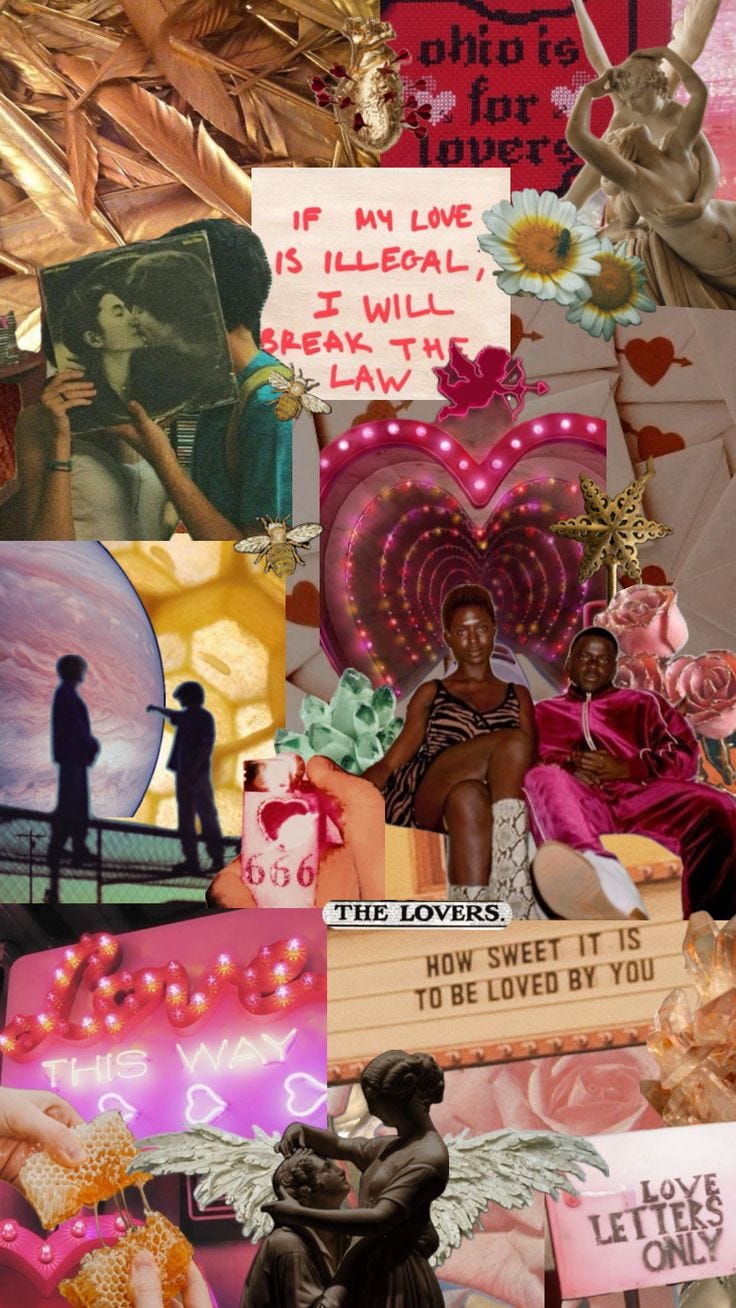
Visual Spells for The Lover


My final thoughts on The Lover:
Find The Lover in coming-of-age art, specifically queer coming-of-age stories.
Don’t just trust me, Trust Doechii, the Hip-Hop Disruptor Of The Year
I didn’t include this in The Lover playlist, but it deserves an honorable mention as a good representation of The Lover contemplating their first big decision.
They weren’t wrong. I was the cheater. But we’ll talk about Justice soon enough.